

ABOUT US

GREETINGS
Dr. Atsushi KUMANOGOH
COMING SOON!
The Univesiy of Osaka UNESCO ChairholderProfessor Elli SUGITA
The Univesiy of Osaka UNESCO Co-ChairholderEmeritus Professor Beverley Anne Yamamoto
There is an intimate relationship between health and education. School success is harder to achieve for children with health vulnerabilities. At the same time, schools are ideal places for health promotion and prevention activities, as well as to support the inclusion of children and young people with health vulnerabilities. We established the UNESCO Chair to focus on extending the research base around health promotion in school settings with a particular focus on Asia and sexual and reproductive health. We aim also to expand educational offerings concerned with school-based health promotion that is ready to engage with advancements in technology, including AI, and understandings of how health is co-produced.Why do we need the UNESCO Chair GHE
We want to bring innovative ideas and perspectives together on the question of enhancing global health and health promotion. We bring not only a public health background to these pressing issues, but also social and human sciences. Our research and educational activities to date are strongly rooted in a social approach with a focus on reducing inequalities and vulnerability, addressing diversity, and inclusion issues, and working with participatory and democratic models of engagement.
Providing support, changing structures,taking on children’s futures
-

- Working to address inequalities
-

- Education improves health and is the key to correcting inequalities
-

- Fairness and inclusion: Promoting fairness and inclusion in schools and the community is a priority
-

- Diversity: All individuals, schools, and local communities share both similarities and differences
-

- Ethics: Ethical issues are at the heart of health education
-

- Accumulating evidence: Platforms to accumulate and disseminate knowledge and experience, based on scientific evidence
Contributions from Japan and Osaka University
- Key Cocept is “Social Design for Health”
- From Individual to Planetary Level
- Life Course Approach
Lessons Learnt from Japan
- School & Education
- Healthcare System
- Hyper-ageing Society
- Post-disaster Reconstruction
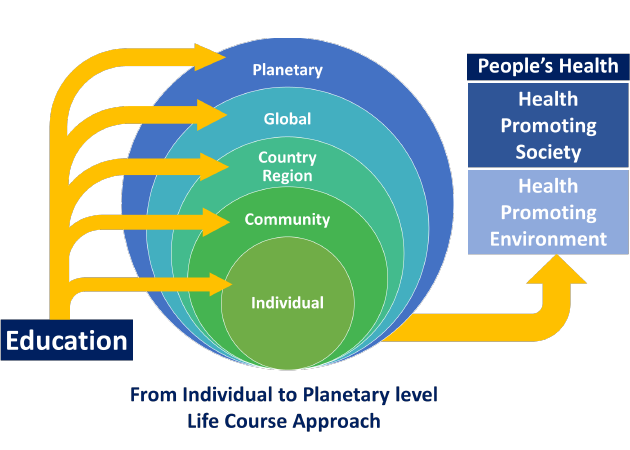
Japan has made significant achievements in education and health, both at the national and international levels. It has a system of universal health care that is cheaper and yet offers wider coverage than many other comparable systems globally. This is in addition to an equitable educational system that is accessible to most children and young people. Such a health-supporting environment has made it possible for Japan to enjoy the highest life expectancy in the world. Yet, there remain longstanding and newer issues that need our attention. These include sustainability of the health and welfare system in the light of a hyper-ageing society, widening health disparities, the rising burden of non-communicable diseases and global epidemics of communicable diseases that require urgent cross-border responses. At the same time, we have the promise and risks involved in new AI technology and its implementation into health care. To address many of these issues, appropriate interventions are needed not only at a policy level, but also in our educational and lived environments. Japan must also more proactively address both mental health and sexual and reproductive health. Our social lives must be redesigned around the principle of “health for all.” Thus, our guiding principle is “a social design for health.”
- TOP
- About Us